
Views: 0 Author: Site Editor Publish Time: 2025-09-04 Origin: Site
When selecting a mold for preform in the household goods sector, the key design considerations are durability, functionality, and aesthetics. Whether for kitchenware, cleaning products, or personal care containers, understanding how mold characteristics influence the end product is crucial for achieving quality results. In this guide, we’ll explore how preform mold design choices can impact the durability, functionality, and visual appeal of household containers, ensuring both cost-effectiveness and compliance with market demands.
Household preforms are unique due to their specific requirements in terms of shape, functionality, and aesthetic appeal. Unlike industrial or pharmaceutical preforms, which may prioritize durability and protection, household preforms often balance visual elements with structural integrity.
Household preforms are typically designed for products that require a variety of shapes and sizes. Common household items such as cleaning bottles, jars, and food containers come in diverse forms—from cylindrical to rectangular. The neck finish, too, varies depending on the type of closure and the product’s end-use. Common neck finishes for household containers include snap-on, screw-on, and flip-top designs, each requiring different mold specifications.
For example, food jars may require a wider neck to facilitate easy pouring, while detergent bottles may require a narrower neck to prevent spillage. Understanding these requirements is essential for creating molds that not only fit the desired shape but also meet the functional demands of the final product.
The visual appeal of household packaging plays a significant role in consumer choice. Transparency is a major factor, especially for products like beverages and cleaning agents, where customers expect to see the contents clearly. To achieve this, mold designers must focus on the mold’s surface finish. A high-quality surface finish ensures that the final preform will have the necessary clarity and smoothness to reflect light in a visually appealing way.
Additionally, many household products incorporate embossing or branding on the packaging. Preform molds can be engineered to create intricate designs that enhance the packaging’s appeal and help brands stand out. The mold must be capable of precise detailing to ensure that the final product meets aesthetic and branding standards without compromising structural integrity.
One of the critical aspects of preform design is ensuring that the mold allows for uniform wall thickness and appropriate blowability, which directly affect the final product’s performance.
When designing a preform mold for household products, wall thickness uniformity is a primary concern. Inconsistent wall thickness can cause weak spots, resulting in durability issues or improper blowing during the molding process. For instance, areas with thinner walls may deform or collapse under pressure, while thicker sections may retain excess material, increasing the weight and cost.
Uniformity in wall thickness also impacts blowability—the ease with which the preform is transformed into its final blown shape. A well-designed preform mold ensures smooth and consistent blow performance, leading to products with reliable durability and aesthetic consistency.
Choosing the right material is crucial for household containers. Polyethylene Terephthalate (PET) is commonly used for many household preforms due to its strength, clarity, and resistance to chemicals. However, different household products have different requirements. For instance, detergents or oils may require specific PET grades to ensure the container is resistant to the chemical properties of the liquid inside.
For example, PET materials with enhanced resistance to oils, detergents, and other chemicals are essential for containers that will be used for cleaning products or kitchen items. Selecting the right grade helps to extend the life of the product and maintain its appearance, even after prolonged use or exposure to challenging substances.
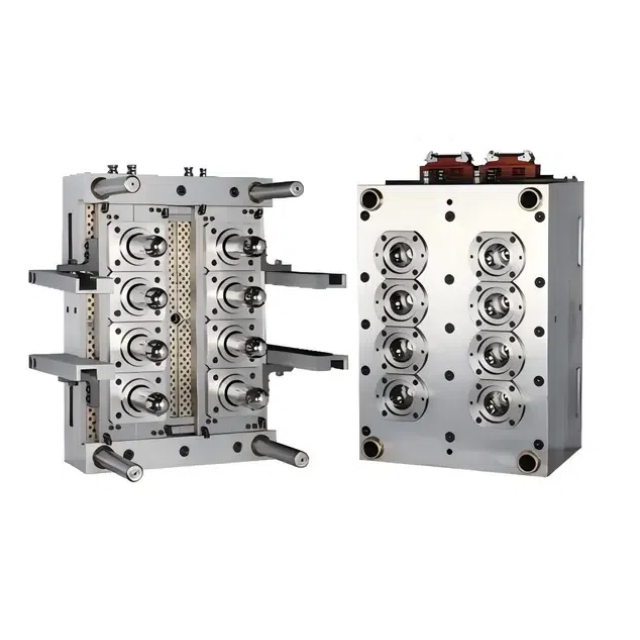
When choosing a mold for preform, tooling choices are essential not just for quality but also for production efficiency. A mold must be designed for high-quality output with minimal scrap and consistent cycle times.
A mold’s cavity count directly affects production efficiency. Molds with multiple cavities allow for the simultaneous production of several preforms in a single cycle, improving throughput and reducing costs. However, this can come at the cost of cycle time, as molds with more cavities may require longer cooling times to ensure that each preform is of consistent quality.
Quality control is essential in this process. Using molds with more cavities requires advanced monitoring systems to ensure that each preform is consistent in terms of wall thickness, weight, and finish. It’s essential that manufacturers use molds designed to optimize both cycle time and quality control.
Hot runner systems are essential for molds that require uniform material flow and consistent product appearance. A hot runner keeps the plastic at an optimal temperature, allowing for better flow and fewer defects. This is particularly important when producing preforms that must meet high aesthetic standards, such as those used in food and beverage packaging.
By using hot runner molds, manufacturers can ensure that each preform has a uniform thickness and smooth surface finish, which is critical for maintaining the desired appearance and functionality of household containers.
Quality assurance (QA) checks play an integral role in ensuring that preforms meet the required standards. After the preform is molded, it undergoes a series of tests to confirm its suitability for further processing.
For household products, preforms must be inspected for a variety of factors. Weight consistency is a primary concern, as variations can affect the final product’s durability and overall appearance. Visual inspections are performed to check for defects in surface finish, clarity, and overall uniformity.
Leak tests are particularly important for products like cleaning liquids or personal care products, where even a small flaw could result in spillage. Ensuring that each preform is leak-proof before proceeding to the blow molding stage is essential for preventing costly defects in the final product.
After a preform is blown into its final shape, it often undergoes additional processes such as labeling, printing, and decorating. The choice of mold can affect these post-blow finishing processes. For instance, certain mold designs may result in surface irregularities or challenges in applying labels and other markings.
To ensure smooth and effective post-blow processing, it’s important to select molds that offer smooth, uniform surfaces and consistent shapes. This will prevent defects during labeling and improve the overall aesthetic quality of the product.
As sustainability becomes more important, reducing material usage without sacrificing strength is a key goal in preform mold design.
One of the primary goals in modern preform mold design is lightweighting—reducing the weight of the preform while maintaining the necessary strength and durability. This is achieved through the use of innovative mold designs that optimize material flow and reduce excess plastic. Lightweighting strategies can help lower production costs and reduce environmental impact.
For example, reducing the preform’s weight by using thinner walls or specialized materials can cut down on raw material usage, which translates into lower production costs and a more sustainable product.
Choosing the right supplier for preform molds can significantly impact both the longevity of the molds and the amount of scrap produced during the molding process. High-quality molds made from durable materials will withstand the stresses of repeated use, while also producing less scrap, resulting in cost savings and improved production efficiency.
Working with an experienced supplier like ShuangLi Technology ensures that your preform molds meet the highest standards for both quality and longevity, helping to reduce waste and optimize manufacturing costs.
In conclusion, selecting the right mold for preform is essential for producing high-quality household containers that meet both aesthetic and functional requirements. By focusing on key design parameters such as wall thickness, material selection, and tooling choices, companies can create durable, cost-effective products that resonate with consumers. ShuangLi Technology specializes in the R&D and manufacturing of precision preform molds that cater specifically to the needs of household packaging, ensuring quality and efficiency in every product.
For more information on our high-performance molds, please contact us.


