
Views: 0 Author: Site Editor Publish Time: 2026-03-19 Origin: Site
Millions of PET bottles move through factories every day. Beverage brands, cosmetic companies, and pharmaceutical producers all rely on this constant supply. Production lines must therefore run fast while still keeping quality stable and costs under control. One technology makes this possible: Multi-Cavity Preform Molds. These molds allow injection machines to form many preforms in a single cycle instead of producing them one by one. Because of this design, manufacturers increase output, improve efficiency, and reduce production costs across large packaging operations.
High-volume industries depend heavily on this capability. Even small efficiency gains can result in millions of additional bottles each year. Leading mold manufacturers such as ShuangLi Technology help support this process through precision machining and durable mold engineering. In this article, we explore how Multi-Cavity Preform Molds increase bottle production efficiency. You will learn how they improve production speed, consistency, and large-scale manufacturing performance.
Before understanding efficiency gains, it helps to understand how PET bottle production begins.
A PET preform is a small plastic tube that looks similar to a test tube. It already includes the bottle neck and thread. Later, blow molding machines heat and stretch the preform into its final bottle shape.
The process works in two main stages:
Stage | Process | Purpose |
Injection Molding | Molten PET injected into a preform mold | Forms the preform |
Blow Molding | Heated preform expanded into bottle shape | Produces final container |
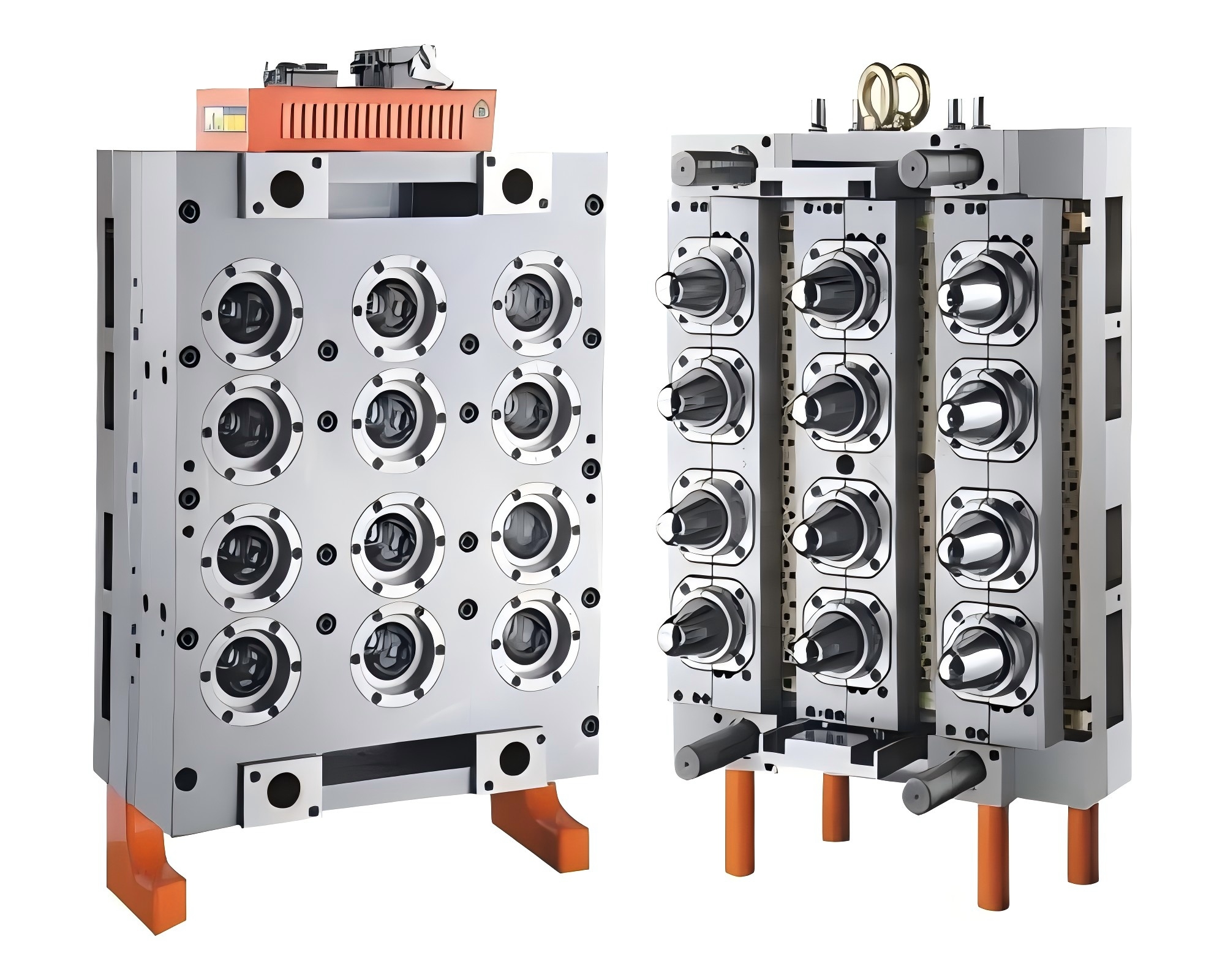
A Multi-Cavity Preform Mold contains many identical cavities inside one mold plate. Each cavity forms one preform during a single injection cycle.
For example:
● 24-cavity mold → produces 24 preforms per cycle
● 48-cavity mold → produces 48 preforms per cycle
● 72-cavity mold → produces 72 preforms per cycle
This simultaneous production dramatically increases throughput.
Instead of repeating the injection process dozens of times, the machine produces many preforms at once.
The preform stage sets the foundation for the entire bottle manufacturing process.
If the preforms are consistent in weight, thickness, and shape, blow molding machines run smoothly. If they vary too much, production problems appear quickly—such as uneven bottle walls or poor sealing.
That is why precision mold design matters.
High-quality Multi-Cavity Preform Molds ensure that every cavity fills under nearly identical conditions. Balanced runners, precise cavity dimensions, and controlled cooling keep every preform uniform.
Experienced mold manufacturers like ShuangLi Technology invest heavily in CNC machining, inspection equipment, and data-based quality control. Their molds help maintain dimensional accuracy across dozens of cavities, allowing production lines to run reliably for long periods.
Several engineering factors explain why Multi-Cavity Preform Molds significantly increase bottle production efficiency.
The most obvious advantage is production volume.
A single-cavity mold produces only one preform during each cycle. By comparison, a multi-cavity system can produce dozens at once.
Example comparison:
Mold Type | Preforms Per Cycle | Relative Productivity |
Single cavity | 1 | Base level |
24 cavity | 24 | 24× higher |
48 cavity | 48 | 48× higher |
72 cavity | 72 | 72× higher |
This multiplication of output allows factories to meet large packaging demands without increasing machine count.
For beverage manufacturers producing millions of bottles daily, this capability is essential.
Cycle time determines how fast each injection process completes.
A typical injection cycle includes:
1. Injection of molten PET
2. Packing and holding pressure
3. Cooling and solidification
4. Mold opening and ejection
Modern Multi-Cavity Preform Molds use carefully engineered cooling channels to shorten the cooling stage.
These cooling channels circulate temperature-controlled water around each cavity. The improved heat transfer allows plastic to solidify faster, reducing total cycle time.
When cycle times drop by even a few seconds, the annual production increase can be enormous.
Tip: Efficient cooling design is one of the most important factors affecting high-volume preform production speed.
Higher production volume spreads operational costs across more units.
In injection molding, many costs remain fixed per cycle:
● Machine operation
● Energy usage
● Labor
● Setup time
When a mold produces dozens of preforms per cycle, those costs are divided across more bottles.
For example:
● Single-cavity mold
○ Cost per cycle: $5
○ Preforms produced per cycle: 1
○ Cost per preform: $5
● 48-cavity mold
○ Cost per cycle: $5
○ Preforms produced per cycle: 48
○ Cost per preform: about $0.10
This comparison clearly shows how Multi-Cavity Preform Molds distribute operating costs across many units. As cavity numbers increase, the cost per bottle drops significantly, allowing manufacturers to achieve far better production efficiency.
Uniformity is critical for bottle quality.
If preforms vary in weight or wall thickness, the final bottles may develop defects during blow molding.
Multi-Cavity Preform Molds solve this problem by producing multiple preforms under the same controlled conditions.
Key factors include:
● identical cavity dimensions
● balanced injection runners
● uniform cooling distribution
The result is highly consistent preforms across the entire production run.
Consistent preforms reduce:
● blow molding defects
● material waste
● production downtime
Another efficiency advantage is improved machine utilization.
Instead of installing several low-output injection machines, manufacturers can run one machine equipped with a high-cavity mold.
This approach offers several benefits:
● reduced factory floor space
● simplified production management
● fewer maintenance requirements
Production teams can manage higher output using fewer machines and operators.
Note: Higher machine utilization improves overall equipment effectiveness (OEE), a key performance metric for modern manufacturing lines.
High efficiency does not come from cavity count alone. Mold design plays a crucial role.
Modern molds require extremely tight tolerances.
Even small dimensional differences between cavities can cause uneven filling or weight variation.
Manufacturers therefore rely on advanced CNC machining systems to produce mold components with micron-level precision.
Uniform cavities help ensure:
● balanced injection flow
● identical preform weight
● stable production performance
Cooling systems require careful engineering. Engineers place water channels strategically around each cavity to remove heat efficiently. Uniform temperature distribution prevents uneven cooling, which could cause deformation.
Cooling design often considers:
Cooling Design Feature | Purpose |
Close channel placement | Faster heat removal |
Balanced water flow | Uniform cavity temperature |
Corrosion-resistant piping | Long service life |
Efficient cooling contributes directly to faster cycle times and stable production output.
High-volume production requires molds that can withstand thousands of cycles per day.
Most Multi-Cavity Preform Molds use high-grade tool steels known for:
● high hardness
● corrosion resistance
● thermal stability
These materials help maintain cavity precision even after years of continuous operation.
Modern mold systems often use modular designs.
Individual components such as cavity inserts, cores, or hot runner parts can be replaced without dismantling the entire mold.
This design offers several advantages:
● shorter maintenance time
● faster repairs
● longer mold service life
Factories can keep production lines running while performing routine servicing.
Efficiency improvements extend beyond the mold itself. They influence the entire production environment.
High-cavity molds reduce the number of machines required to meet production targets.
Instead of managing several low-capacity lines, operators can focus on a smaller number of high-output systems.
Benefits include:
● simplified production supervision
● lower staffing requirements
● improved operational control
Energy is one of the largest costs in plastic manufacturing.
Because Multi-Cavity Preform Molds produce many preforms in each cycle, energy usage per unit decreases.
This improves both:
● production efficiency
● environmental sustainability
Lower energy consumption also helps manufacturers meet sustainability goals.
Injection molding machines represent a significant capital investment.
Using high-cavity molds increases the productivity of each machine.
Manufacturers therefore generate more output without expanding equipment capacity.
Companies like ShuangLi support this strategy by designing molds that balance precision machining, durability, and efficient cooling systems. These features allow production lines to operate reliably for extended periods.
One major advantage of multi-cavity systems is scalability.
Manufacturers can select molds based on their production goals.
Common configurations include:
Mold Type | Typical Use |
8–16 cavities | small production runs |
24–48 cavities | medium-scale production |
72+ cavities | high-volume industrial production |
This flexibility allows factories to expand output gradually as demand grows.
Many industries rely heavily on PET bottle production.
Major sectors include:
● beverage packaging
● pharmaceutical containers
● cosmetic bottles
● household cleaning products
Each of these industries requires consistent, high-volume container production.
Multi-Cavity Preform Molds help manufacturers meet these demands efficiently.
Beyond production efficiency, multi-cavity molds offer long-term strategic advantages.
High-cavity systems allow manufacturers to produce large quantities quickly.
This capability is especially valuable when fulfilling:
● seasonal beverage demand
● large export orders
● rapid product launches
Uniform preforms improve final bottle performance.
Consistent dimensions lead to:
● stable blow molding
● reliable bottle strength
● improved sealing performance
These quality improvements help protect brand reputation.
The combination of high output, consistent quality, and lower per-unit costs improves overall manufacturing profitability.
Manufacturers gain the ability to:
● increase production capacity
● reduce operational costs
● stay competitive in global packaging markets
Efficient bottle production begins at the preform molding stage. Multi-Cavity Preform Molds greatly improve this process by producing dozens of preforms in one injection cycle. This design increases production output while reducing cycle time and manufacturing cost per bottle. At the same time, balanced cavity structures help maintain consistent preform weight and shape, which supports stable blow molding and reliable bottle quality. These advantages make multi-cavity mold systems essential for modern PET packaging lines.
When precision engineering combines with advanced cooling design and durable mold materials, manufacturers gain stronger production stability and higher long-term efficiency. Taizhou Shuangli Technology Co., Ltd. contributes to this progress through high-precision preform mold manufacturing and strict quality control. Their molds are designed for durability, accuracy, and high-volume performance, helping bottle producers improve productivity while maintaining consistent product quality across large-scale packaging operations.
A: Multi-Cavity Preform Molds are injection molds designed to produce multiple PET preforms in a single molding cycle. Each cavity forms one preform, allowing manufacturers to create dozens at once instead of producing them individually. This greatly increases production output and supports large-scale bottle manufacturing.
A: Multi-Cavity Preform Molds improve efficiency by producing many preforms simultaneously. This reduces cycle time per unit, increases machine productivity, and lowers operational costs. As a result, factories can manufacture more bottles without increasing the number of machines.
A: High-volume industries such as beverage and cosmetics require millions of bottles each day. Multi-Cavity Preform Molds allow injection machines to meet this demand by significantly increasing output while maintaining consistent preform quality.
A: Yes. Multi-Cavity Preform Molds spread operating costs such as energy, labor, and machine time across many preforms produced in one cycle. This greatly reduces the manufacturing cost per bottle, making them more economical for large-scale production.
A: A Multi-Cavity Preform Mold can include different cavity counts depending on production needs. Common configurations include 24, 48, or even 72 cavities. Higher cavity numbers allow factories to achieve larger production capacity.
A: Industries that require high volumes of PET containers benefit the most. These include beverage packaging, pharmaceuticals, cosmetics, and household products. Multi-Cavity Preform Molds help these industries maintain fast production speeds while ensuring stable bottle quality.


