Views: 0 Author: Site Editor Publish Time: 2026-07-26 Origin: Site
The financial stakes in PET manufacturing remain remarkably high. Once engineers cut steel for a complex tool, modifications become prohibitively expensive. They also consume massive amounts of precious time. You simply cannot afford physical trial and error today. This reality makes digital simulation a critical manufacturing requirement. It serves as a mandatory validation gate. This gate securely bridges the gap between digital part concepts and physical manufacturing. By simulating the injection molding process, engineers accurately predict material behavior. They identify severe risks long before CNC machining begins. In this article, you will discover powerful engineering strategies. We show how leveraging simulation actively prevents costly tool recuts. We will explore how these insights optimize cycle times directly. You will learn how to guarantee structural integrity before deploying significant capital.
Risk Mitigation: MFA acts as a digital twin, identifying potential defects (e.g., short shots, warpage) before physical prototyping.
Cost & Time ROI: Eliminates the traditional "trial and error" approach, drastically reducing tooling modification costs and accelerating time-to-market.
Performance Optimization: Validates cooling layouts and runner systems, which is critical for maximizing output in a multi-cavity PET preform mold.
Application Versatility: Essential for complex geometries, including a high-cavity jar bottle preform mold or a high-precision edible oil preform mold.
The traditional trial-and-error approach drains corporate budgets rapidly. Cutting hardened steel commits your manufacturing capital permanently. Fixing a design mistake requires extensive welding, wire EDM, and repolishing. These aggressive rework processes damage the steel's fundamental structural integrity. Furthermore, hidden costs frequently dwarf the direct machining expenses. Missed product launch windows cost brands thousands of dollars daily in lost retail revenue. Delayed packaging approvals disrupt the entire supply chain.
Digital simulation eliminates this outdated guesswork entirely. It functions as an objective, data-driven decision tool. Smart manufacturers approve a PET preform mold design only after it passes strict simulation thresholds. You must treat simulation data as the ultimate authority before purchasing tooling steel.
A successful simulation report must demonstrate specific engineering outcomes. We define a "passed" analysis using these strict success criteria:
Balanced volumetric filling across every single cavity.
Acceptable material shear rates avoiding thermal degradation.
Uniform cooling temperature gradients maximizing production speed.
Minimized clamp force requirements preventing machine wear.
Zero indications of air traps or prominent weld lines.
Common Mistake: Skipping simulation to save upfront engineering costs always leads to severe downstream delays. You will spend five times the simulation cost on a single tool recut.
Project Phase | Relative Modification Cost |
|---|---|
Digital Design Phase | $ |
Pre-Machining (MFA) | $$ |
Post-Machining (First Cut) | $$$$ |
Post-Trial (Physical Sample) | $$$$$$$ |
The hot runner system dictates the final quality of your preforms. Proper PET preform moldflow analysis predicts internal pressure drops accurately. It maps shear heating occurrences throughout the manifold. Gate sizing remains incredibly vital for PET processing. Undersized gates cause excessive shear stress during injection. This severe stress breaks polymer chains rapidly. Broken chains generate Acetaldehyde (AA) within the plastic. High AA levels ruin the taste of bottled water completely. Simulation visualizes these shear rates, allowing engineers to resize gates safely.
Cooling consumes the largest portion of any injection molding cycle. Your cooling efficiency drives your production return on investment directly. PET is a semi-crystalline polymer. Uneven cooling causes premature crystallization inside the cavity. This localized crystallization turns clear plastic hazy and brittle. Digital simulation prevents this visual defect completely. It highlights hot spots across the core and cavity. Engineers then design conformal cooling channels to eliminate these specific thermal imbalances. You achieve faster cycle times while maintaining perfect optical clarity.
Long, thin preforms face severe core shift risks. High injection pressures push the core pin off-center easily. This deflection creates uneven wall thicknesses. Simulation predicts this exact bending force meticulously. We can adjust gate geometry or wall thickness based on these insights. Software also maps potential weld lines and air traps accurately. We adjust venting locations proactively based on this thermal data. You secure flawless cosmetics before physical manufacturing ever begins.
Best Practice: Always model the entire hot runner system during simulation. Never settle for modeling just a single cavity. Manifold imbalances cause most multi-cavity production failures.
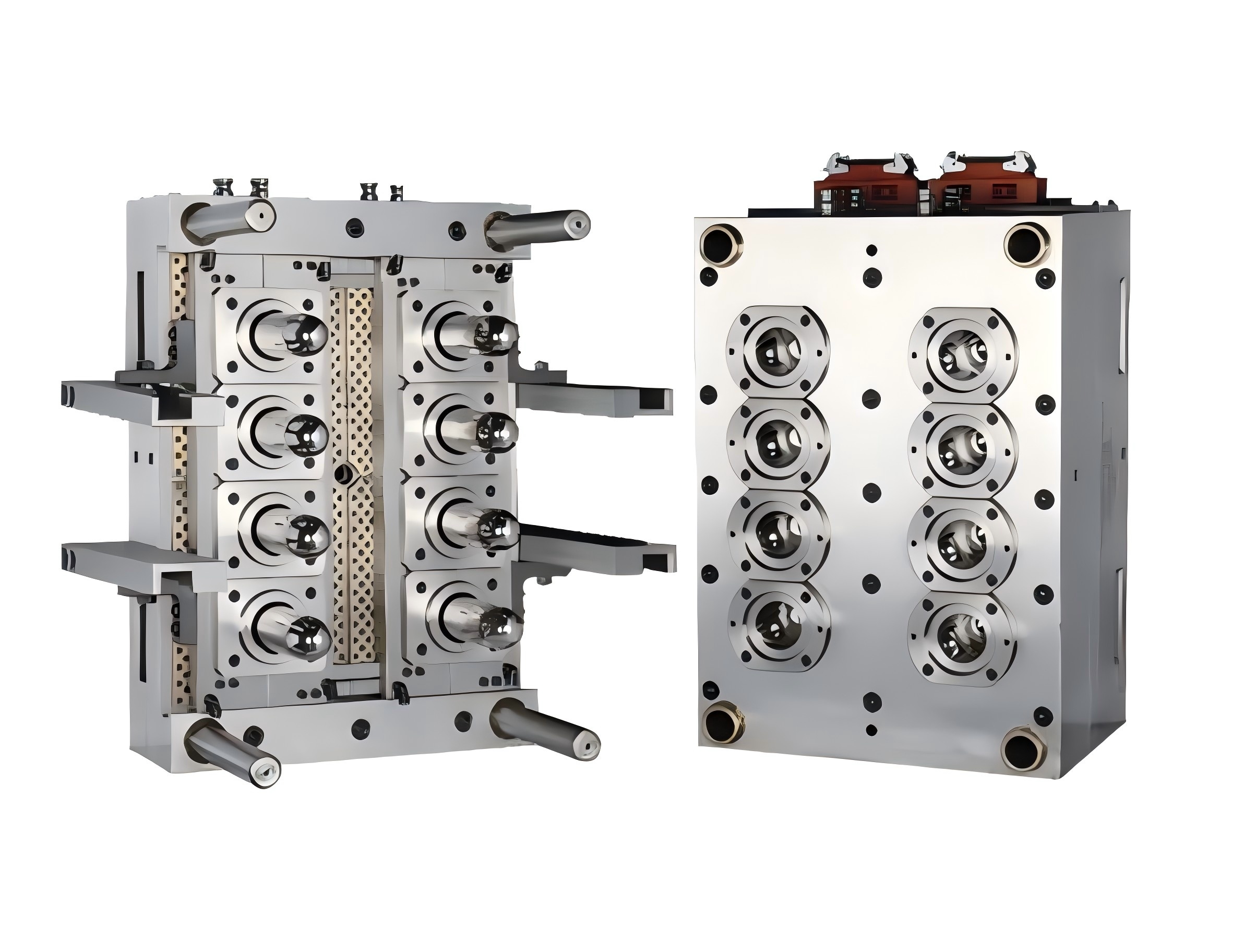
High-volume production environments present massive balancing challenges. You must balance polymer flow precisely across massive manifolds. The 96th cavity must fill exactly like the first cavity. Minor flow imbalances cause short shots or severe flashing. A well-designed multi-cavity PET preform mold relies entirely on perfect runner balancing. Simulation verifies this intricate manifold design perfectly. It ensures uniform pressure distribution across all drops. You guarantee consistent part weights and identical dimensional stability for every single preform.
Wide-mouth jars require highly unique tooling geometries. A standard high-cavity jar bottle preform mold possesses a massive projected area. This large area demands extreme machine clamping forces. High material viscosity increases these pressure requirements even further. If ignored, the mold will flash continuously. Simulation helps optimize flow fronts across these wide dimensions. It prevents ugly flow marks on large preform surfaces. Engineers adjust injection speed profiles to keep clamp tonnage well within safe limits.
Edible oil packaging demands extremely tight manufacturing tolerances. A dedicated high-precision edible oil preform mold typically features heavy walls. Thick plastic walls cool slowly and shrink unevenly. This unpredictable shrinkage warps specialized neck finishes easily. Warped necks cause oil leaks during downstream capping processes. Simulation predicts volumetric shrinkage behavior meticulously. Engineers apply precise holding pressures to compensate for this specific shrinkage. You achieve perfect dimensional stability for tamper-evident neck rings.
Raw simulation data holds severe limitations. The software acts merely as a predictive calculator. A colorful heat map means absolutely nothing on its own. Success depends entirely on human engineering expertise. You need an experienced plastics engineer interpreting these complex rheological patterns. They must understand the Cross-WLF viscosity model deeply. Inexperienced users often ignore critical shear stress warnings. Seasoned experts will adjust a gate diameter by 0.1mm to fix it.
Do not settle for basic reporting when evaluating vendors. Demand actionable Design for Manufacturability (DFM) solutions. Your vendor should explain exactly what geometry needs changing. They must justify these changes using the simulation data.
Simulation Output (Raw Data) | Actionable Engineering Insight (DFM Solution) |
|---|---|
High pressure drop identified in manifold. | Increase main runner channel diameter by 2mm. |
Shear rate exceeds material limits at gate. | Open gate orifice by 0.15mm to reduce shear heating. |
Core pin deflects 0.3mm during filling. | Profile injection speed; slow down velocity at 85% fill volume. |
Uneven volumetric shrinkage near neck ring. | Extend holding pressure time and add independent cooling circuit. |
Material data accuracy determines your overall simulation success. Generic PET profiles cause massive simulation errors. You must input specific resin grade characterizations into the software. Different intrinsic viscosities behave wildly differently under high pressure. Using generic data skews pressure predictions by up to 30 percent.
You must evaluate a tooling partner's internal simulation capabilities rigorously. Many manufacturers outsource this critical step to generic design houses. This separation breaks the feedback loop between design and physical trials. The best manufacturers perform analyses in-house. They correlate their digital predictions with actual physical mold trials constantly. This continuous validation improves their internal engineering standards.
Ask these specific questions when evaluating a potential mold manufacturer:
Is your flow analysis performed in-house by dedicated plastics engineers, or is it outsourced?
How exactly do you validate your simulation data against actual first-shot physical results?
Do you possess specific material database profiles for our chosen PET resin grade?
Can you provide a sample DFM report showing how simulation changed a previous tool design?
Your immediate next step involves demanding data. Request an analysis-backed proposal for your next preform project. Refuse any quotes relying purely on traditional guesswork.
Investing in upfront digital simulation protects your manufacturing investment reliably. It eliminates the catastrophic costs associated with physical steel modifications. You accelerate product launches by getting the design right the first time. Modern injection molding leaves absolutely no room for guesswork. Good design relies purely on empirical data and expert engineering interpretation. Leveraging this technology secures perfect cosmetics, rapid cycle times, and dimensional stability. Contact our expert engineering team today to request a customized moldflow consultation and project quote.
A: No simulation guarantees a flawless first physical sample. It significantly reduces initial design errors and tooling iteration rounds. Physical dialing-in of the injection molding machine remains required. Engineers must still adjust real-world pressures, temperatures, and hold times. Simulation simply gives you an optimized starting point.
A: A standard simulation typically requires three to five business days. Complex runner systems or higher cavity counts extend this timeline slightly. Engineers need this vital time to run multiple design iterations. Rushing this analytical process often yields incomplete or inaccurate data.
A: Yes, we strongly recommend it. Replicating a tool often involves changing the resin grade or machine specifications. Cycle time targets might also shift. These variables drastically alter internal flow dynamics. Simulation ensures the replicated tool performs optimally under these new manufacturing conditions.